
PUR Insulation & Spray Foam
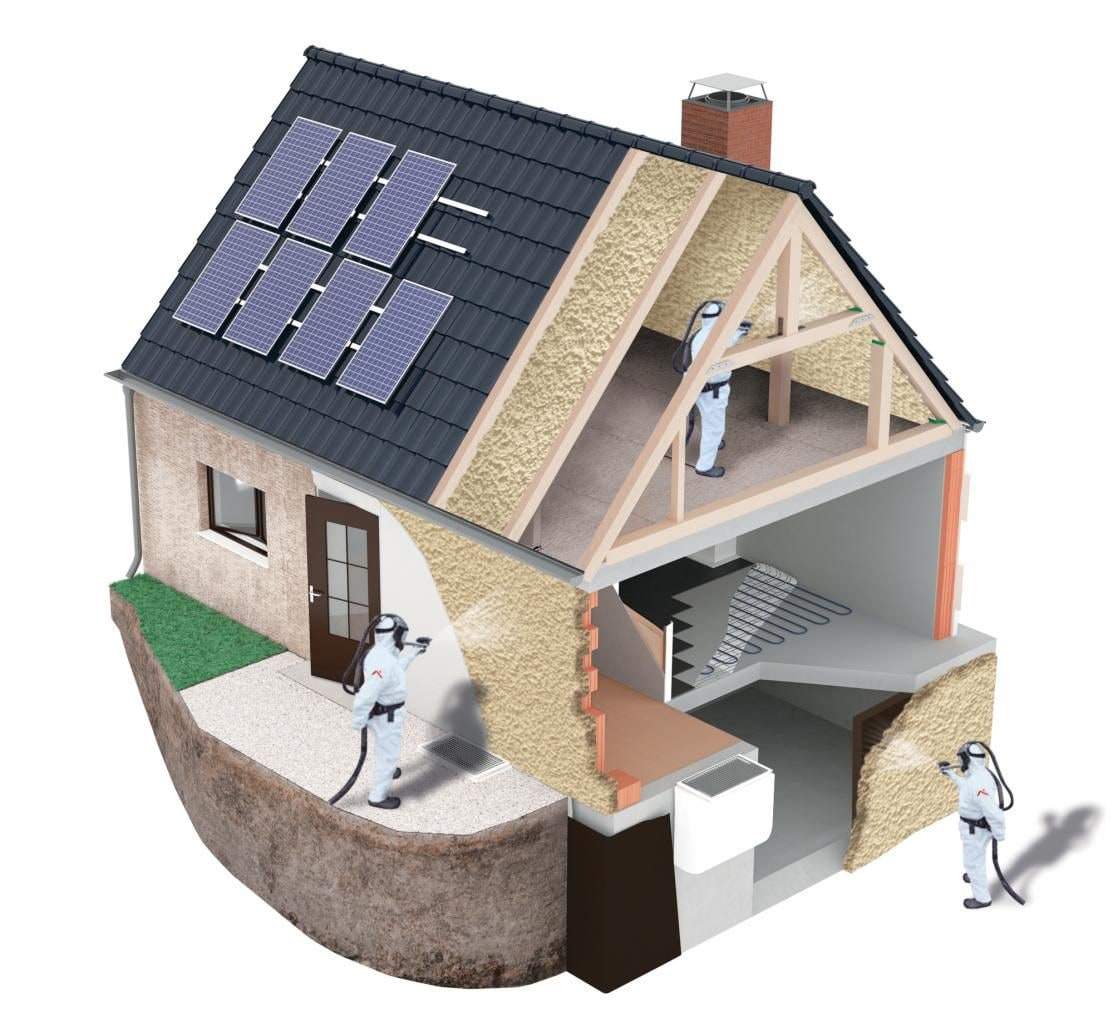
Seamless polyurethane spray insulation for roof, wall and floor.
Two-component PUR spray foam (DIN EN 14315-1/2) – seamless, joint-free thermal insulation on roof, attic, wall, façade, base plate and industrial halls. Open-cell PUR for sound insulation and breathable assemblies, closed-cell PUR for high mechanical loads, vapour-tight insulation and floor stabilization. Processed in a 2K spray process – cures in seconds, fully load-bearing within minutes.
Your benefit
- Seamless – no thermal bridges
- Air-tight in one step
- Excellent values at low thickness
- Form-stable, no settling
Material properties
Six key benefits
Effective insulation
Parameter stability
Tightness of insulation
High performance
Low layer weight
Excellent adhesion
Vorteile
Warum PUR Insulation & Spray Foam?
Seamless insulation
No joints, no thermal bridges – the PUR foam creates a fully closed insulation layer in one work step.
Highest energy efficiency
WLG 023–028 (closed-cell) means the lowest thermal conductivity at minimal thickness – meets KfW-55 / 40 standards.
Air-tightness
Air-tight layer per DIN 4108-7 in one step – without additional foils or tapes.
Moisture protection
Closed-cell PUR is vapour-tight and rot-proof – ideal for cold roofs, basements and damp areas.
Fast application
100 m² roof in 1 day – sprayed, cured, ready. No drying or curing times.
Ideal for roof, halls & industry
Adheres to steel, concrete, wood, masonry – ideal for trapezoidal sheet roofs and complex geometries.
Cost comparison
PUR foam vs. mineral wool
For a roof or attic area of 100 m² in Germany, the typical cost difference between PUR foam and mineral wool – incl. material and installation – looks roughly like this.
| Material | €/m² | 100 m² |
|---|---|---|
| PUR open-cell (attic) | 35–60 €/m² | 3,500–6,000 € |
| PUR closed-cell | 60–100 €/m² | 6,000–10,000 € |
| Mineral wool (standard) | 25–50 €/m² | 2,500–5,000 € |
PUR advantages
- ✓ No thermal bridges
- ✓ Air-tightness
- ✓ Faster installation
- ✓ Better values at lower thickness
- ✓ Does not settle
- ✓ Ideal for complex roof geometries
PUR disadvantages
- ! Higher initial investment
- ! Requires professional team and equipment
Mineral wool advantages
- ✓ Lower material costs
- ✓ Good acoustics
- ✓ Easily available
Mineral wool disadvantages
- ✗ Possibility of settling
- ✗ Thermal bridges with poor installation
- ✗ More difficult air-tightness
- ✗ Absorbs moisture
- ✗ Longer installation
Insulation performance comparison
For example:
- 20 cm PUR open-cell ≈ 25–30 cm mineral wool
- 10 cm PUR closed-cell ≈ approx. 18–20 cm mineral wool
What is more often chosen in Germany today?
For new roofs and premium renovations, increasingly:
- ●Spray Polyurethane Foam Insulation + vapour barriers / membranes
- ●For complicated roof structures
- ●For old roofs
- ●For used attic spaces
- ●For moisture problems
Mineral wool still dominates for:
- ●lower-budget investments
- ●DIY systems
- ●cost-driven developer construction
▸At current energy prices in Germany, professionally executed Spray Polyurethane Foam often pays back its higher upfront cost faster thanks to air-tightness and lower heat losses.
Normen & Qualität
Nach DIN/EN ausgeführt
Alle Arbeiten erfolgen nach den aktuellen deutschen und europäischen Normen – mit dokumentierter Schichtdickenmessung und CE-konformen Materialien.
DIN EN 14315-1
In-situ PUR/PIR spray foam – material requirements
DIN EN 14315-2
Installed product specification & execution requirements
EN 13165
Factory-made PUR/PIR thermal insulation products
DIN 4108
Thermal insulation & air-tightness in buildings
GEG
Gebäudeenergiegesetz – German Buildings Energy Act
DIN EN 13501-1
Reaction-to-fire classification (Euroclasses)
DIN 4102
National fire behaviour classification (B1/B2)
DIBt-Zulassung / aBG
General building authority approval (national use proof)
Building energy losses
Energy loss diagram
in residential buildings
Measurements for a single-family house with 128.4 m² of floor area, located in Greater Poland, with full insulation (roof, ceiling, wall, floor) at 18 cm thickness and the same thermal conductivity coefficient [W/m·K].
Source: Polychem Systems – technical study on energy losses in residential buildings.
Measurements for a single-family house with 128.4 m² of floor area, located in Greater Poland, with full insulation (roof, ceiling, wall, floor) at 18 cm thickness and the same thermal conductivity coefficient [W/m·K].
Insulation comparison
Insulation layer thickness at the same thermal resistance
At identical thermal resistance (R-value), PUR foam requires the thinnest insulation layer of all common materials — a decisive advantage in tight build-ups and slim wall assemblies.
Closed-cell
PUR foam
Polystyrene
(EPS)
Mineral
wool
Wood
▸For the same energetic effect, PUR foam needs only 25 mm — 5.6× less than wood and almost half the thickness of mineral wool.
German Standards & Regulations
German Standards & PUR Regulations
Spray-applied PUR/PIR foam (Spritzschaum) and polyurea coatings in Germany are governed by one of the strictest normative frameworks in Europe. The full stack — from material standards through energy law (GEG), fire classification, emissions, polyurea waterproofing and mandatory REACH applicator training — must be documented before any Bauleiter signs off.
Material standards
- DIN EN 14315-1 Sprayed rigid polyurethane foam produced in-situ on the construction site — material properties, classification and performance requirements.
- DIN EN 14315-2 Specification for the installed insulation product — in-situ application requirements, quality verification and applicator qualification.
- DIN EN 13165 Factory-made PUR/PIR rigid foam thermal insulation products — specification and performance.
Energy & insulation requirements
- GEG Gebäudeenergiegesetz — the German Buildings Energy Act setting binding minimum thermal performance and primary energy demand for new builds and refurbishments.
- DIN 4108 Thermal insulation and energy economy in buildings — including Part 3 (moisture protection) and Part 7 (airtightness, Luftdichtheit).
- DIBt abZ / aBG Allgemeine bauaufsichtliche Zulassung / allgemeine Bauartgenehmigung — German national fitness-for-use approval, required for many non-standardised PUR systems.
Fire protection
- DIN EN 13501-1 European fire classification (Euroclasses A1–F with s1–s3 / d0–d2). For PUR spray foam typically B-s2,d0 or B-s1,d0 in tested system assemblies.
- DIN 4102 Legacy German fire classification (B1 schwerentflammbar / flame-retardant, B2 normalentflammbar / normally flammable) still widely referenced in German specifications.
- MBO / LBO Musterbauordnung and federal-state building regulations define minimum fire class per building class and component type.
Emissions, health & indoor air
- AgBB Bewertung Health-related evaluation scheme of the Ausschuss zur gesundheitlichen Bewertung von Bauprodukten — required for DIBt-approved products used indoors. VOC and SVOC emissions measured at 3 and 28 days.
- Blauer Engel / eco-INSTITUT Independent environmental and pollutant certifications (Blauer Engel, eco-INSTITUT, natureplus) — the relevant emission and pollutant labels for PUR spray foam in the premium segment.
- TÜV certificates Independent third-party testing and certification of material safety, durability and declared performance — a strong commercial argument for architects and planners.
- DIBt abZ / aBG National fitness-for-use approval — confirms the product is regulatorily fit for use in German construction and is the entry condition for AgBB indoor assessment.
Polyurea waterproofing & corrosion protection
- DIN 18531 Waterproofing of roofs — both non-utilised and utilised roof areas. Reference standard for liquid-applied polyurea on roofs.
- DIN 18533 Waterproofing of building elements in contact with the ground — basements, foundations, plinths. Defines water exposure classes W1.1-E to W4-E.
- DIN 18534 Waterproofing of indoor wet rooms — bathrooms, showers, commercial kitchens. Water exposure classes W0-I to W3-I.
- DIN EN 1504 Products and systems for the protection and repair of concrete structures. Polyurea coatings are classified as surface protection systems (OS systems).
- DIN EN ISO 12944 Corrosion protection of steel structures by protective paint/coating systems. Corrosivity categories C1–CX and durability ranges (e.g. VH ≥ 25 years).
- DIN EN ISO 4624 Pull-off test for adhesion of coatings — mandatory acceptance test for polyurea coatings on concrete and steel.
- DIN EN ISO 2808 Determination of dry-film thickness — the basis for the thickness protocol required across the entire coated surface.
Contractor requirements (mandatory in DE since 2023)
- REACH-Verordnung EU REACH regulation — mandatory diisocyanate training since 24.08.2023 for operators working with products containing > 0.1% monomeric diisocyanates. No valid training certificate, no PUR spraying.
- Applicator certificate Manufacturer system-training combined with the DIN EN 14315-2 competence proof. Prerequisite for sites under DIBt abZ / aBG approval.
- TRGS 430 / PPE A2P3 Risk assessment per TRGS 430, ambient-air-independent respirator (fed-air system / compressed-air hose) or A2P3 half-mask, chemical protective suit, goggles and gloves — during spraying and reaction time.
- Ventilation & documentation Ventilation measurement and protocols, indoor re-entry waiting periods after spraying, complete technical documentation incl. SDS, TDS and batch traceability.
What German Bauleiter & Sachverständige actually check — the 10 mandatory items
Every experienced Bauleiter and certified surveyor (Sachverständiger) runs a fixed checklist on-site. Missing any of these items can trigger acceptance refusal, warranty exclusion or building-authority complaints.
- 01 CE marking and ETA (European Technical Assessment) of the foam system — without these documents the material cannot legally be installed.
- 02 DIBt abZ / aBG (general building authority approval or Bauartgenehmigung) for the in-situ foam system used in Germany.
- 03 Lambda value (thermal conductivity λ) of the foam — proof per DIN EN 14315-1, the design value for GEG compliance.
- 04 Fire class per DIN EN 13501-1 (e.g. B-s1,d0 / B-s2,d0) and/or per DIN 4102 (B1), depending on component and use.
- 05 Sd value (water vapour diffusion-equivalent air layer thickness) — condensation and moisture protection proof per DIN 4108-3 (Glaser method or hygrothermal simulation).
- 06 Complete execution documentation: spray protocol, substrate preparation, climate/temperature values, material batches.
- 07 Thickness protocol with measurement points across the entire surface — minimum and mean against the energy target.
- 08 Applicator training certificate per REACH (diisocyanate training) and manufacturer system-training.
- 09 Public and professional liability insurance of the contractor with proof of cover amount and validity.
- 10 Technical data sheet (TDS) and safety data sheet (SDS) per REACH Art. 31 — to be presented on site.
★ Premium
What gives an edge in the German premium segment
In the German premium segment, price is rarely the deciding factor — documentation, traceability and certified quality are. The following elements separate a standard contractor from a system partner trusted on demanding projects.
- Certified applicators with manufacturer system-training, REACH diisocyanate training and documented project references in residential and industrial construction.
- Complete DIN/GEG documentation: lambda design value, U-value proof, condensation and airtightness analysis per DIN 4108, with GEG-compliant handover.
- Thermographic measurements before and after — objective proof of insulation performance, detection of thermal bridges and leakage.
- Execution and thickness protocols (DIN EN ISO 2808) with measurement grid, photo documentation and batch traceability — audit-ready archived.
- System warranty in cooperation with the foam manufacturer — extended guarantees on material and workmanship within tested system assemblies.
- Close cooperation with manufacturers and independent test institutes (TÜV, DIBt, eco-INSTITUT, Blauer Engel) — fast clarification on special cases and project-specific approvals.
▸Top-tier systems on the German market combine ETA, DIBt-Zulassung / aBG, Blauer Engel or eco-INSTITUT certification, TÜV testing and full QNG/GEG compatibility. This combination is what separates a code-compliant site from a legally watertight, energetically demonstrable and sustainably documented premium refurbishment.
Where we work
Private, commercial, industrial – we come to you with the right equipment.
Roof insulation (rafter, on-rafter, under-rafter)
Attic insulation (top floor ceiling)
Wall & façade (interior insulation)
Cold storage, halls, floors
Pipe and pipe insulation
Closed-cell PUR – WLG 023–028
Open-cell PUR – WLG 035–045
Spray foam DIN EN 14315-1/2
Rechtliches
Gewerbe- & Identitätsnachweis
Gemäß deutschem Handwerksrecht – Eintragung in der Handwerksrolle sowie Identitätsnachweis des Inhabers öffentlich einsehbar.
Bauakte
Documentation & Site Management
Every project is documented seamlessly – for you, your energy consultant and the building authority.
Thickness measurement report
Grid measurement per DIN EN 14315-2 with photo and date.
Warranty documents & CE conformity
Material safety data sheets, CE marking, REACH application records.
Site management & log
Daily site documentation, temperature/climate log, handover protocol.
Photo documentation before/after
Existing state, preparation, finished insulation layer – as PDF building file.
Förderung
Funding Programs
PUR spray insulation is eligible under BEG WG (Federal Funding for Efficient Buildings). We deliver all required proofs.
Federal Funding for Efficient Buildings – Residential
Subsidy up to 20% for insulation on roof, wall and top floor – via BAFA application.
Federal Office for Economic Affairs and Export Control
Single measures building envelope incl. iSFP bonus 5% with individual renovation roadmap.
Reconstruction Loan Corporation
Programme 261/262 – low-interest loans with repayment subsidy for energy-efficient renovation.
Hinweis: Application and energy consultant proof MUST be filed before contract award. We support with all material and thickness data.
Bereit für PUR Insulation & Spray Foam?
Kostenloses Angebot innerhalb von 24 Stunden.
Alles aus einer Hand
Electrical Engineering
Planning, installation and commissioning of electrical systems per DIN VDE 0100.
Photovoltaics & Energy Systems
Direct conversion of sunlight into electricity – turnkey systems per EEG.
Polyurea Coating
Fast-reacting 2K elastomer coating system in hot-spray process.
Floor Lifting & PU Injection
Lifting sunken concrete floors using PU injection (foam jacking / slab lifting).
Industrial Systems
Industrial wiring, switchgear, machine connections per DIN VDE.
Fibre Optic & Network
Structured cabling per EN 50173 incl. measurement protocol.
Alarm & Security Systems
Intrusion detection systems with VdS-approved components.
Fire Protection Systems
Fire alarm systems and fire protection per DIN 14675.
Core Drilling
Precise core drillings up to Ø 350 mm in concrete and masonry.
Smart Home & Building Automation
KNX/EIB, Loxone, Bus systems and IoT integration.
Electrical Measurements
DGUV V3, E-CHECK, insulation, RCD, loop impedance per DIN VDE 0100-600.
Evacuation Systems
Voice alarm systems & escape route guidance per DIN VDE 0833-4.